The Insider’s Guide to Branded Podcasting
Share this story
Listen up, B2B marketers. Here’s how podcasts can increase awareness, build trust and strengthen your company’s rep as a thought leader.
Contents
The Great Podcasting Boom
Brands are investing big in podcasts and taking the medium in new directions.
Podcast Power
Who’s consuming what — by the numbers.
Building Connections and Cred
Audiences are hungry for genuine expertise. Here’s how organizations are using podcasts to feed that need — and positioning themselves as true thought leaders.
Breaking Through the Noise
Podcasters face immense competition — and not just from other brands. To break through the noise, your series must have a distinct value prop that hooks listeners from the get-go.
Ready? Set. Podcast!
From choosing the right equipment to building buzz, marketers have some homework to do before — and after — they step behind the mic.
Now Hear (and Watch) This
The podcast universe continues to evolve. Never fear. We’ve rounded up some future-forward predictions — and pro tips — to keep you on the right path.
The Great Podcast Boom
Once seen as a small-but-mighty niche, podcasting is fast emerging as a marketing must-have. It’s got everything brands need to make a statement. The drama of TV. The smarts of a well-reported magazine article. The immersive audio wizardry of radio. Done right, podcasts offer the best features of media rolled into one beautifully compelling and portable package. It’s also proven remarkably malleable as creators twist and turn the medium, trying out new formats and adding video.
While the term “podcast” didn’t enter the vernacular until 2004, it’s been around since the earliest days of the internet. But unlike dial-up modems and AOL Instant Messenger, podcasts have proven staying power. Much of that has to do with a little phenom known as Serial, NPR’s ridiculously addictive whodunit that pulled in some 300 million downloads with its first season — and snagged the first-ever Peabody Award given to a podcast.
That was just the start. With listenership skyrocketing year over year, brands wasted no time in adding podcast sponsorships and on-platform ads to their paid media strategies. Global podcast ad spend was expected to top $5 billion in 2025, according to research from WARC Media. Nearly half (46%) of that investment comes from the United States, as big-name advertisers like Amazon, Toyota and Capital One hop on high-performing shows. One standout stat? Half of B2B marketers were planning to spend more in 2025 on podcast advertising, per a 2024 study by Madison Logic.
It wasn’t long before marketers began using podcasts as a form of owned media and building branded versions, each specifically created for their company’s target audience. An especially potent content catnip, the best branded podcasts don’t just speak to people about the subject they care about — they engage consumers in a direct and intimate way that forges an authentic connection. Case in point: Google’s Search Off the Record brings listeners into the inner circle by serving up behind-the-scenes scoops with an insider POV — like asking whether SEO is dead. Or consider L’Oréal Groupe’s This Is Not a Beauty Podcast with host Isabella Rossellini. Yes, she talks about beauty, but it’s more like listeners are hanging out with Rossellini and her friends as they discuss “the serious role beauty plays in things we take seriously,” like how lipstick has become a key economic indicator. Each franchise has found a way to put their brand at the center of lively conversations — helping them click with their audiences in a meaningful way.
Sounds good, right? Let’s dive in. Whether you’re looking to launch your very own branded podcast or perhaps reimagine the one you have, we’ve got some pro tips on how to make it happen.
Podcast Power
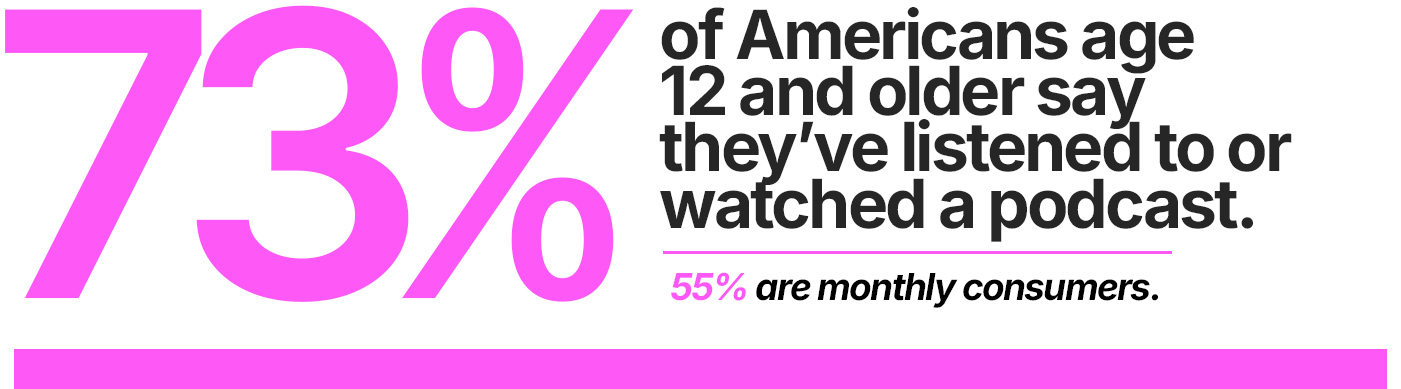
People are consuming podcasts at an all-time high.

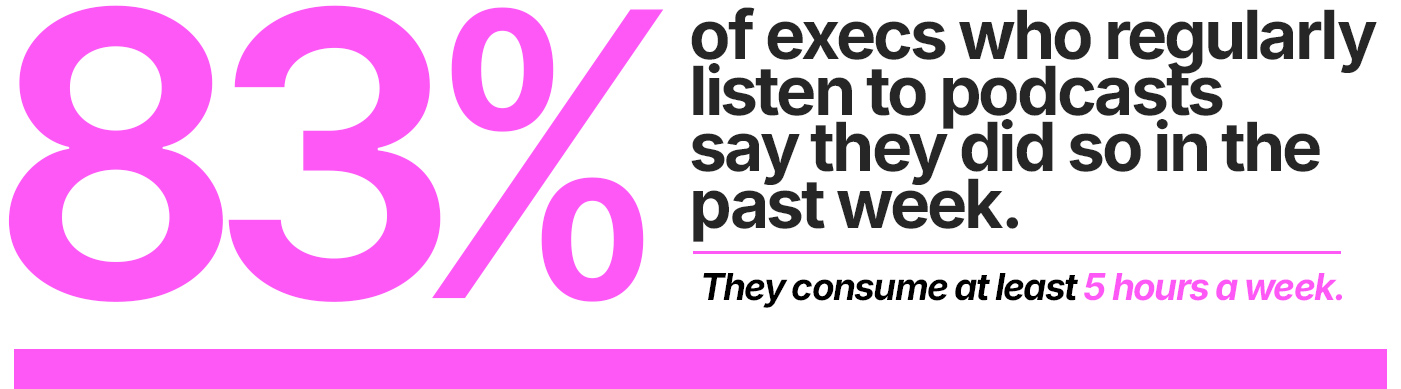
The podcast crowd includes the all-important-but-oh-so-elusive executive audience. And these folks tend to tune in — a lot.
“There’s a podcast for that.”
The podcast universe is vast, with something for just about everyone — no matter what they’re into.
2 in 3 people say podcasts are the best way to learn about the things they’re interested in.
Execs lean toward business and education. And they’re more than 2x as likely to listen to technology podcasts than other podcast listeners.
What are business leaders looking to get out of their podcasts?
- Self-improvement (35%)
- Inspiration (35%)
- Challenges to their thinking (25%)
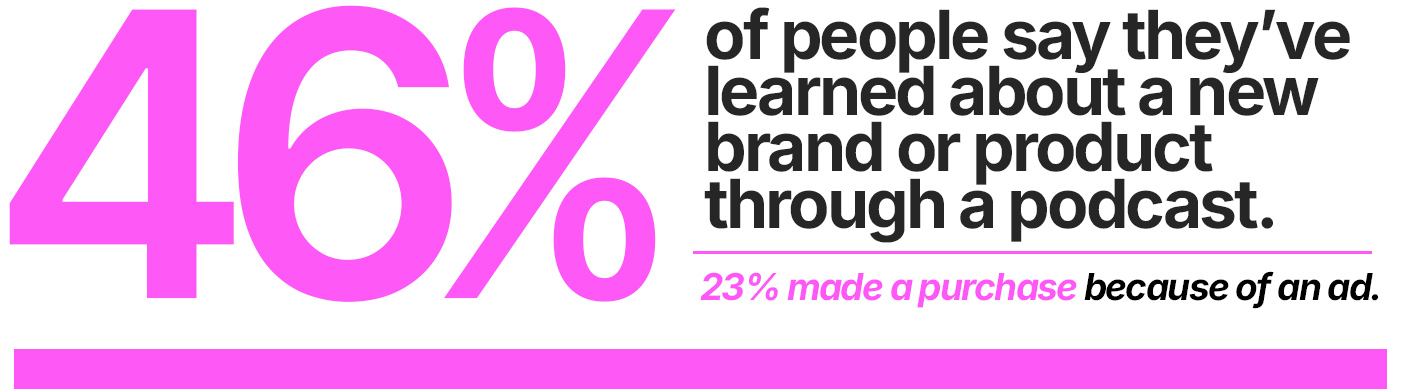
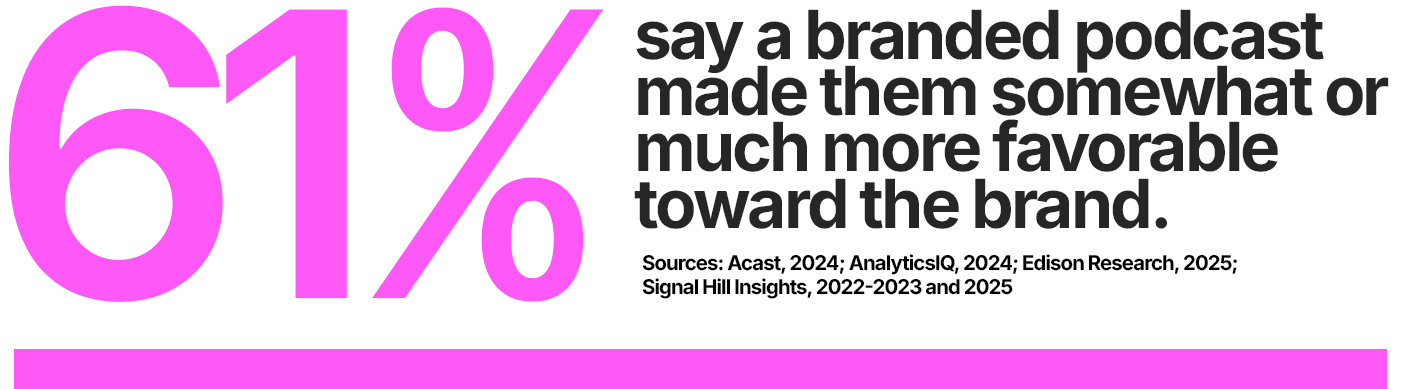
The Brand Boost
Building Connections and Cred
Crank Up the Thought Leadership
Audiences are hungry for information rooted in genuine expertise. And podcasts can be a super-effective way to meet that audience need. But you better know your raison d’être.
Because right now, teams are cranking out a whole lot of wannabe thought leadership. We’ve all fallen prey to gated whitepapers that turn out to be glorified sales pitches, or articles that promise a fresh take but merely rehash the same old, same old.
Only 15% of decision-makers rank the overall quality of thought leadership they consume as very good or excellent, according to a 2024 report by Edelman and LinkedIn.
And while there’s no doubt that tried-and-true vehicles like whitepapers, videos, blogs and magazines will continue to be part of a robust thought leadership strategy, many brands are adding podcasts to the mix.
Yet it’s still an underused vehicle, with marketers reporting only 11% of their brand’s thought leadership is delivered via podcasts, per a 2025 iResearch Services survey.
That’s unfortunate. They’re missing out on a creative and engaging way to:
- Provide content that addresses actual audience needs
Everyone’s got their own pain points. With a little research, a brand can create a podcast that answers its customers’ most pressing (and searched) questions — building their rep as a thought leader in the process. On Project Management Institute’s Projectified® podcast, for example, project leaders walk through how they’re navigating real-life issues. The result: Listeners take away useful tips — and the association is seen as a go-to resource. - Meet the audience wherever they roam
Portability has long been a staple in the case for podcasts. It’s a completely moveable feast that users can engage with as they’re driving, on a run or at home doing the dishes. Even if brands decide to add video for a little visual flair, the experience isn’t dependent on it. Either way, the episodic nature of podcasts leaves listeners expecting — and wanting — more, creating a loyal subscriber base. - Lead with in-house expertise
Every company holds a trove of insider knowledge and homegrown brainpower. Podcasts are a creative way to unlock that expertise and transform it into engaging content with a distinct POV. The Society for Human Resource Management’s The AI+HI Project, hosted by Alexander Alonso and Nichol Bradford, puts SMEs out front — offering a distinct take on the intersection of artificial and human intelligence. - Demonstrate brand beliefs
People are looking at more than just price these days: 64% of Americans say they actively choose brands that resonate with their personal values, according to a 2024 Ipsos survey. Podcasts let marketers communicate their ethos in an organic, authentic way. REI Co-op’s Wild Ideas Worth Living aligns directly with the brand’s mission — and boasts an impressive 85% episode completion rate. - Humanize the brand
The power of audio lies in its personal nature. It’s inherently human, which helps brands build a connection with listeners. Red Hat’s Command Line Heroes blends narration, music, sound effects and interviews to pull listeners into epic true tales of how open source rebels are revolutionizing the technology landscape.
Podcasts are a powerful way to:
- Drive brand awareness
- Build a strong tie to customers
- Highlight your brand values
- Share your expertise
The payoff? Enhanced credibility and connection.
Connecting Across Verticals
What makes podcasts particularly powerful is their shape-shifting versatility. They can be used to reach virtually any demographic across a range of verticals and industries — whether it’s a Gen Zer in Santiago learning about smart factories from a tech company’s podcast, or a baby boomer in San Francisco tuning in for retirement advice from a financial services firm.
B2B
Customers look to B2B brands for more than just products and services. They also want to learn from their expertise. Nearly three-quarters of decision-makers say an organization’s thought leadership content is a more trustworthy basis for assessing its capabilities than marketing materials and product sheets, according to Edelman and LinkedIn.
For many forward-thinking B2B brands, podcasts are a powerful platform to provide genuine value and share deep knowledge in the subject areas that matter most to their audiences. Yet even as consumption increases, only 27% of B2B marketers use podcasts, per a 2024 Content Marketing Institute survey.
Associations and Nonprofits
Associations and nonprofit organizations have a long-established reputation for creating story-driven content. Podcasts are an immensely effective outlet for telling evocative, human-focused stories — whether it’s someone sharing how they were helped by a philanthropic group or an SME walking through a project in the field.
Many professional associations also create podcasts centered around education and career advancement, often offering professional development credits for listening.
Consumer
Podcasts can absolutely build brand awareness, but the best ones provide real value. Compared with B2B audiences, consumers are far more sensitive to overt marketing — which means brand leaders must take care to identify the right theme, message and positioning.
Breaking Through the Noise
It’s Getting Crowded in Here
There are more than 4.6 million podcasts out there, according to Podcast Index LLC — and that number just keeps growing. Companies with podcasts face immense competition — and not just from other brands. Yet far too many aspiring podcasters will simply record a 20-minute meandering monologue or a conversation that’s really a glorified ad for their brand — then upload the audio file and wonder why they’re not seeing results.
So heed this: In a sea of self-anointed gurus doling out sometimes-questionable advice, brands that can offer trustworthy insights will find a hungry audience: 2 in 3 people say podcasts are the best way to learn about the things they’re interested in, per Acast. The same report showed 66% of respondents say podcasts provide more in-depth discussions of a topic than other forms of media.
Deep down, everyone just wants to feel understood. And the most effective way for companies to address that most fundamental of needs is by digging into the minds of their customers — creating content that’s tailored to their goals, habits and desires. Yet while marketers have long waxed poetic about the power of an audience-first approach, far too many remain hyperfixated on their own business goals. To truly serve their audience, brands must flip their focus and build a podcast that’s valuable, interesting and sometimes even a little provocative. That means remaining laser-focused on deepening relationships rather than pushing products.
By their very nature, podcasts can create a powerful connection between the brand and the audience. Acast’s study found that half of podcast consumers report feeling like they’re part of a community by tuning in to shows. And although podcasts are growing at an exponential rate, there’s still room for more. Even niche topics like wealth management or cybersecurity can be turned into exciting podcast journeys with the right ingredients.
The title and theme of your series needs to be focused, yet flexible — especially if the goal is to produce multiple seasons. Pigeonholing your show into something that’s too specific can make it hard to continue identifying relevant stories.
When people think of podcasts, they usually imagine the standard format, with a single host interviewing one or two guests. There’s no arguing with the power of that. But there’s also plenty of turf to explore. Consider The Curious History of Your Home. Host Ruth Goodman uses a simple monologue narrative coupled with music and sound effects to weave glorious stories around a series of mundane household objects. Who knew 30-plus minutes on seemingly snoozy topics like laundry and wallpaper could be so intriguing?
And then there’s the whole idea of adding video — fundamentally challenging the very definition of a podcast in the process. While plenty of podcasters are sticking to audio-only, nearly half are in exploration mode producing both audio and video, per a 2025 report by Podcast Marketing Academy and Lower Street.
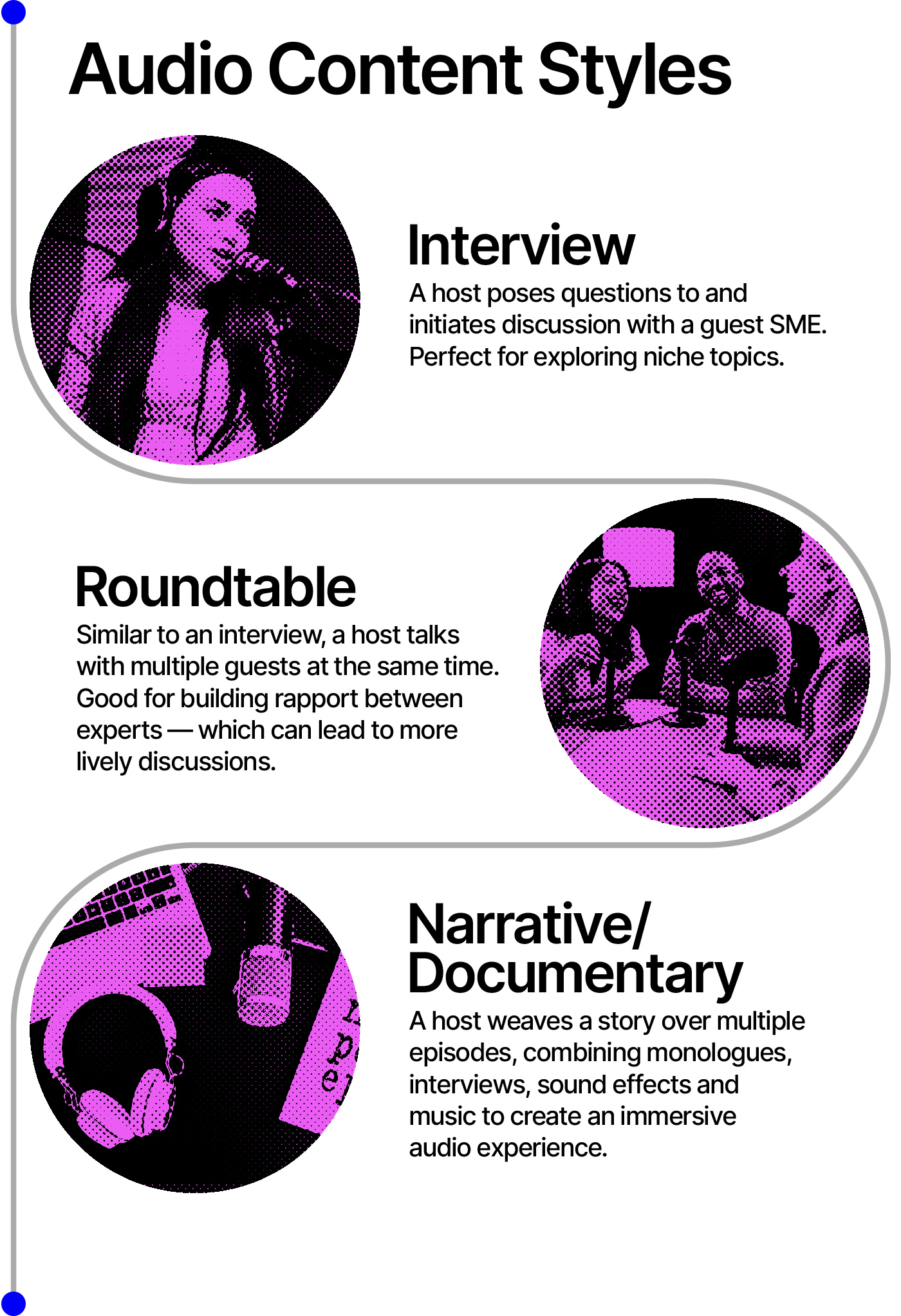
The Essential Elements
Like any piece of content, a well-produced brand podcast starts with a solid strategy. What does it take? Here are our must-haves:
Specificity
Rather than casting a wide net, provide niche insights for your target audience. Acast’s report found that 4 out of 5 listeners tune in to podcasts with a narrow focus. These listeners find niche podcasts offer more value and deeper insights. The payoff for brands? Audiences have a stronger connection and sense of loyalty.
Innovation
In a crowded landscape, podcasts that subvert the standard formula are more likely to stand out. That can mean experimenting with video, partnering with an influencer, doing live episodes at an event, or exploring emerging trends and topics that aren’t being covered elsewhere.
Consistency
Find a publishing cadence that works for you — and stick to it. Commit to a schedule you can keep, but don’t space out your episodes so much (or release them so sporadically) that subscribers lose interest. If you can’t commit to a full season, consider a miniseries.
Value
Do a deep dive into what your audience actually wants and needs. Then think about how you can deliver on that in a way that aligns to your brand mission. Listeners need a reason to seek you out.
Ready? Set. Podcast!
Bringing the Vision to Life
Podcast consumers are a savvy lot. They have high expectations — and they’re going to hold branded podcasts to the same standards as those produced by professional media folks. Nobody has patience for low-quality audio or rambling conversations with no payoff. Consider this: Of the nearly 3 million podcasts on Apple, just 15% were still active as of January 2025. Think The Hunger Games: No podcast can survive without killer content, backed by quality production and a stellar marketing blitz.
Here’s the brutal reality: Podcasts require a lot of work. You’re going to need to think carefully about production, from choosing the right equipment and creating schedules to identifying and booking guests. Then you’ll need to edit your recordings into something that people want to consume. Even the most free-flowing, conversational podcasts call for a significant level of research, scriptwriting and thoughtful editing. Given the dedication required, it’s easy to see why so many fall victim to “podfade.”
To avoid disappearing into podcast oblivion, you’ll need a plan, starting with a decision on frequency. Your choices include:
- Series: Episodes are built around a specific theme or topic and released in a regular cadence — typically every week or two — over the course of a season.
- Miniseries: A limited number of themed episodes — typically four to eight — tell a complete story. These can be dropped all at once or batched out.
- Microcast: Think high frequency. Published several times a week or even daily, this short-form content — usually spanning 2 to 10 minutes — is used to convey quick bursts of the latest info and trends.
36.7 minutes
Median podcast episode length
Source: Podcast Marketing Academy and Lower Street
Now, the real fun begins. When it comes to actually creating your podcast, you’ve got a few options:
- Tackle it in-house: This will require team members with the chops to handle things like scouting good guests, scriptwriting, interviewing, audio editing and marketing. You’ll also need to make sure those people have enough time to consistently see episodes through from start to finish.
- Call in backup: Teams with the bandwidth to handle some production but a lack of in-house expertise to execute highly specialized tasks like scripting or audio editing might consider adding some outside help from contractors or agencies.
- Let the experts handle it: If it all seems a little overwhelming, you could opt to partner with an agency to handle everything from ideation to publication. (And yes, this is where we’ll mention that The MX Group has plenty of podcasting experience — and a stack of awards for our work.)
No matter the resourcing, you’ll need to nail down your process. A detailed production plan and schedule will keep the team on track and ensure episodes hit regularly.
1.) Start with storylines
This is where you’ll need to channel your inner journalist and define your angle for each episode: What do you hope to cover? Why does it matter to your audience? How does it help advance your brand mission? Who will be featured? What distinct POV can you and your guests bring to the topic at hand?
2.) Get scripting
All podcasts, regardless of format, will require some degree of scripting. This might include creating an outline, drafting interview questions, researching or simply identifying the big talking points you want to hit during the interview. It’s the best way to make sure you get the content you need to make each episode valuable to your audience.
3.) Do a test run
their stuff, they might not have a ton of experience doing interviews. So set up time to test equipment, walk them through how it all works and answer any questions. If you’re planning to record video, ask to see your guest’s background setup and check their lighting. It doesn’t have to meet Hollywood standards — but you don’t want any distractions, either. Even if they’re total podcast pros, a trial run will put everyone more at ease when it’s time to record.
4.) Hit record
As a general rule, plan on recording more than you think you’re going to use. We’ve learned the hard way: It’s way better to have more content to work with than not enough. And make sure you’ve got the right equipment to capture audio that’s clear and free of distracting sounds or frequencies. If you’re adding video to the mix, the production lift obviously goes up — you’ll need to make sure everyone looks and sounds good.
5.) Edit and finesse
“Kill your darlings,” as they say. Each episode should be cut, refined and polished until it becomes the kind of ultra-engaging and tightly spun story that no one would dare to tune out. Be ready: That might mean snipping away at parts you’ve fallen in love with.
6.) Optimize it
Even podcasts need SEO love. As part of your prep work, take a close look at how keywords could be incorporated in elements like your show page, as well as titles and descriptions for individual episodes. And don’t forget to include a transcript.
7.) Get it out there
Once you’ve got your episode in the can, you’ll need to publish your files to a hosting platform and then distribute it to all the major outlets. For brands in particular, it will likely take some work to build an audience. So just like any new product, your podcast will need a promotional push, whether it’s a full-on ad blitz or a series of audiograms and video cuts for your social channels. Remember, to get maximum ROI, you should also be cross-pollinating podcast material across your whole content ecosystem.
8.) Lastly, measure and refine
You know the drill: Define your KPIs, review the numbers and iterate accordingly. Granted, analytics available through most podcast hosting and streaming platforms offer only a limited view into overall performance. If you have a podcast landing page set up on your website, use your preferred analytics platform to take a deeper dive. This isn’t all about downloads. Even if you’re not going with full-on video, for example, you should still be posting episodes on YouTube — and those numbers will come in as views. You must be ready to act on the numbers, too. Figuring out things like where people drop off and what topics perform the best (and worst) help determine what your audience really wants — which can help shape the future of your series.
To Video or Not To Video: That Is the Question
YouTube isn’t just the go-to spot for video. It’s been building quite a fan base among the podcast crowd, too. From hosting webinars to offering creators more analytics, the company has been making big investments in podcasting — and it’s paying off. YouTube is now the most popular podcast consumption platform in the United States, with the company exceeding 1 billion monthly active podcast viewers in January 2025. And there’s not much competition coming from Spotify on the video front: Only 25% of its users say they actively watch a video podcast (versus 83% who listen to an audio podcast), per a 2025 survey from Coleman Insights and Amplifi Media.
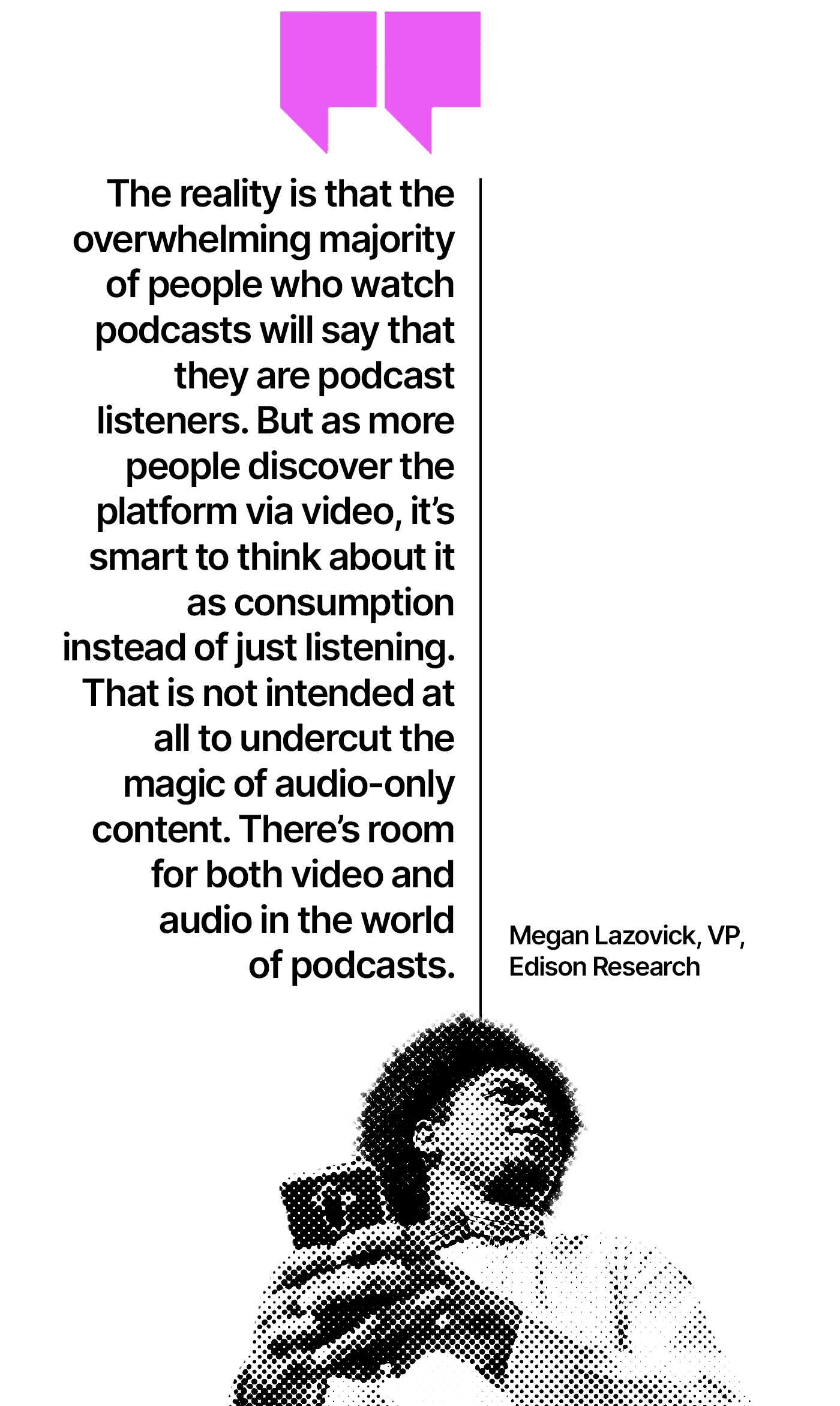
This is a prime example of meeting the audience where they are. Nearly half of U.S. adults (42%) say they prefer consuming podcasts with video, according to a 2024 Morning Consult survey. Among the top reasons for that? An improved ability to focus on the show’s content and a desire to see the hosts’ and guests’ facial expressions. The shift is especially profound among Gen Z: A mere 10% say they only consume podcasts via audio, per Coleman Insights and Amplifi Media.
Yet in the end, most people (77%) alternate between audio and video. That puts the onus on marketers to weigh the ROI for what is a decidedly more arduous production lift. Podcasting with video could also limit the breadth of guests. SMEs are typically the lifeblood of branded podcasts — and not all of them may be comfortable on video. Plus, if you’re scheduling recordings across time zones, that adds another layer of complexity. And let’s face it, podcasts will be going up against videos engineered to go viral, versus staying hyperfocused on building the kind of for-your-ears-only audio experience that keeps listeners tuned in. It’s also worth noting that audio-only podcasts maintain the attention edge, with a median consumption time of 24 minutes versus 7.5 for podcasts on YouTube, according to Podcast Marketing Academy and Lower Street. That same survey found that podcast producers are splitting the difference, with 49.8% relying on both audio and video, 48.9% sticking to audio-only and a mere 1.3% moving to video-only.
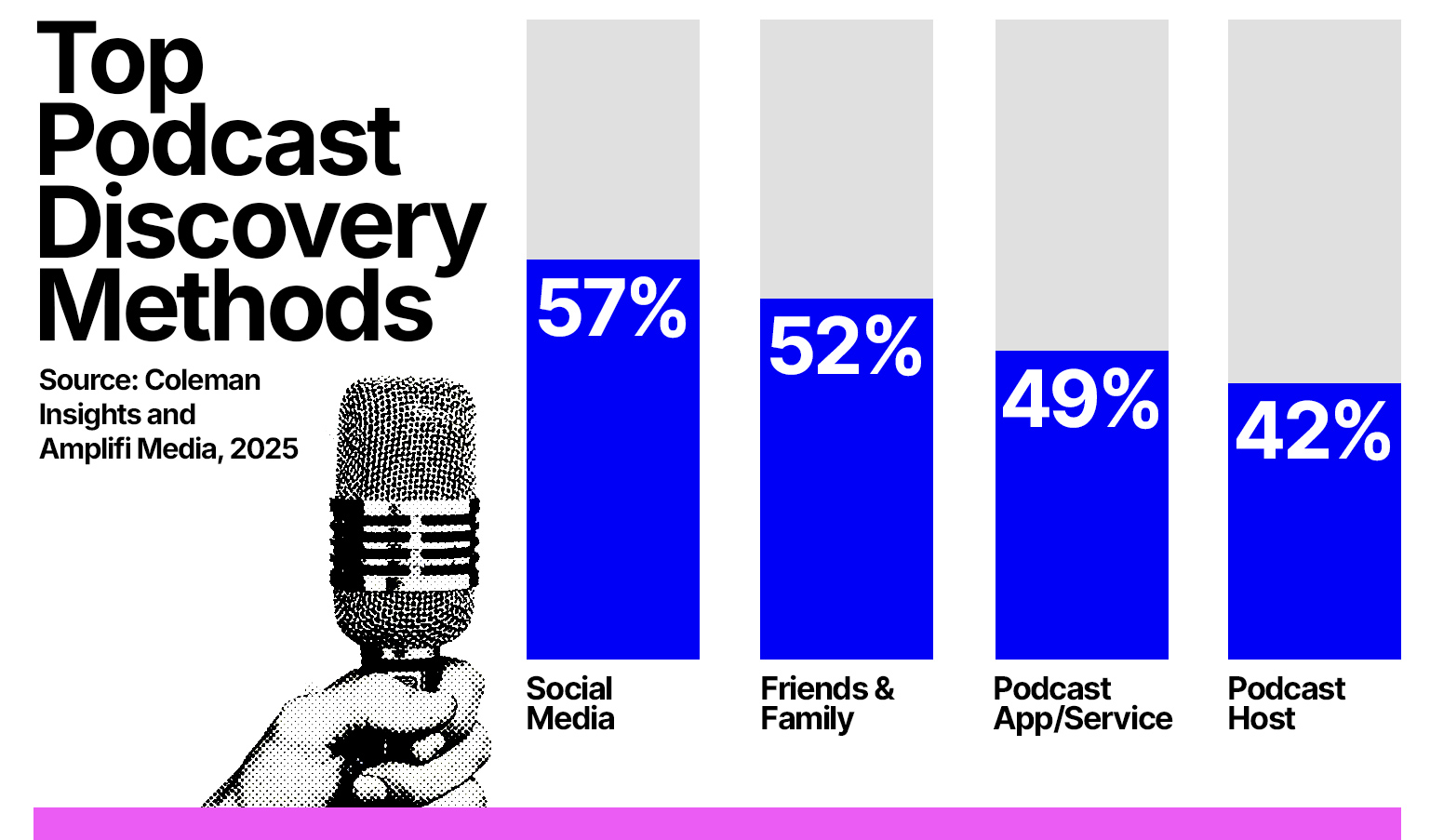
Still, there’s no denying the power of YouTube to boost discovery. It’s already the second-largest search engine. And its all-powerful algorithm serves up a steady supply of videos that seem to magically align with the user’s interests. That has many consumers turning to the platform for suggestions: YouTube ranks second only to personal recommendations in helping consumers find new shows, per 2024 research by Sounds Profitable and Signal Hill Insights.
The big takeaway: Make sure your podcast is on YouTube somehow — whether it’s posting audiogram clips on YouTube Shorts, sharing highlights in the main video feed or going all in with fully loaded video episodes.
Get Smart:
46% of podcast viewers on YouTube say they watch on a smart TV, often in their living rooms on those mega screens.
Source: Coleman Insights and Amplifi Media
How Podcasters Are Using Video
- Shorts repurposed from podcast episodes — 56%
- Full episodes with minimal video production — 48%
- Full episodes with static image or waveform — 42%
- Full episodes with significant production — 24%
- Source: Podcast Marketing Academy and Lower Street
Now Hear (and Watch) This
Recruiting — and retaining — users for a branded podcast requires creative vision and serious planning. And even as podcast consumption reaches new heights, competition is fierce: While 45% of podcast producers see download growth, 55% report a downturn, per Podcast Marketing Academy and Lower Street.
Even the most established players can’t coast. Much like social media, the podcast space moves fast. Don’t panic, though. We’ve got a few futureproofing tips:


Resources
- The Infinite Dial 2025, Edison Research, 2025
- Podcast Pulse, Acast, 2024
- Podcast media sets sights on video boom, WARC Media, 2025
- New Survey from Madison Logic by The Harris Poll Reveals B2B Marketers Will Be Investing More in Social Media Advertising, AI Tools, Video and Podcasts in 2025, Madison Logic, 2024
- Triton Digital Podcast Metrics Demos+ survey, Triton Digital and Signal Hill Insights, 2022-2023
- 2025 Benchmark Report: Branded Podcasts, Signal Hill Insights, 2025
- Podcast Listening Behaviors, AnalyticsIQ, 2024
- Reaching Beyond the Ready: Thought Leadership’s Impact on Engaging Out-of-Market B2B Buyers, Edelman and LinkedIn, 2024
- Thought Leadership in Practice, iResearch Services, 2025
- B2B Content Marketing Benchmarks, Budgets, and Trends: Outlook for 2025, Content Marketing Institute, 2024
- Podcast Marketing Trends 2025, Podcast Marketing Academy and Lower Street, 2025
- The State of Video Podcasting, Coleman Insights and Amplifi Media, 2025
- Are Podcasts the New TV?, Morning Consult, 2024
- The Podcast Landscape, 2024, Sounds Profitable and Signal Hill Insights, 2024